
It is 2026 and the Question on everyone’s mind is, will this be the year for new beginnings. The answer is Yes!…Well if you are referring to renewable energy.
Several major solar projects are scheduled to come online or reach key milestones in South Africa in 2026, marking a significant expansion in renewable energy capacity, particularly for industrial users and private power producers.
Although there have been many tried and failed objection attempts from competition.
The reality is that this renewable energy provides important employment possibilities as well as skills development for South Africans. Not to mention the stability of energy supply it will provide to South Africa.
In the last years, South Africa has more actively utilized its natural renewable energy resources to change its course on dominant fossil fuels like coal in the future. South Africa’s geography favours wind, hydropower, and solar energy, making them the country’s leading renewable sources. These resources now account for a growing share of electricity generation, driven by supportive regulations and shifts in the energy market. (Statisa)
Solar Energy in particular, has been successful on every scale it has been done. Thus, being the leading Renewable Energy Resource in South Africa.
Before a single panel is placed, there is an enormous number of studies, permits and construction that takes place. These phases determine the core structure and outcome of a solar power plant here are several key points:
- Land availability and ownership constraints
- Solar resource potential
- Grid connection feasibility
- Environmental impact and protected zones
- Regulatory and permitting requirements
Once the solar project’s viability is determined, developers decide on the system size based on energy targets and project goals.
Thereafter a site is chosen. Site selection is more than just identifying sunny locations. It involves navigating multiple constraints while preserving buildable acreage.
When moving to the next phase the Layout is very important. The layout is where solar potential meets real-world constraints. It defines how efficiently a site can convert sunlight into electricity and how costly it will be to build. At this stage, engineers define the optimal tilt and orientation of solar panels, row spacing to avoid self-shading and improve airflow, land usage strategy — balancing density, terrain, and constructability, and how to reduce grading and adapt to slopes or irregularities.
Once designs, layouts, permits, and other elements are in place, the project moves into the field, ensuring adherence to the design plans and safety standards. This phase includes: (https://pvcase.com/blog/building-solar-farm-basics)
- Civil works and foundation installation
- PV module mounting and cabling
- Final testing and commissioning
The actual Civil Work and Foundation Installation is extremely important if not the most crucial phase of all. To guarantee prolonged and structural endurance Correct Pole Positioning and Depths across thousands of Solar Piling Foundations demands professional expertise and equipment. These Solar Foundation Holes are drilled over various ground foundations that needs experienced operators and correct Equipment and Drilling Machines.
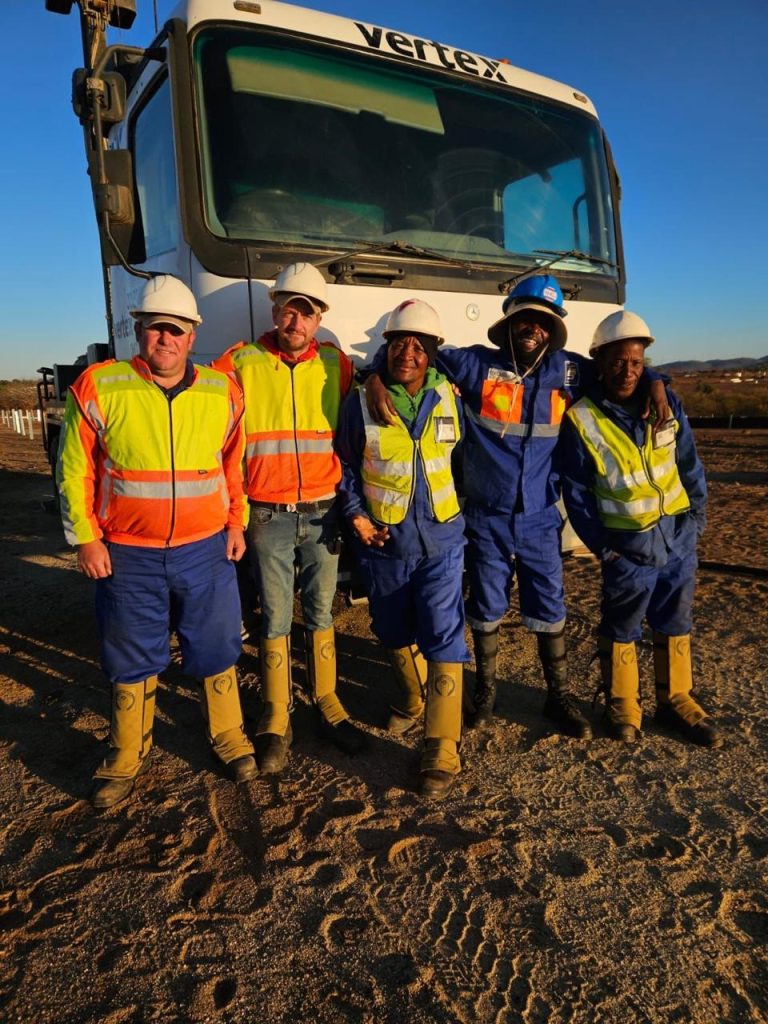
Vertex Drills is privileged to have manufactured and drilled on Multi-Million Rand Solar Renewable Energy Projects in South Africa.
Known by experience, Vertex Drills understands the standard and excellence of Drilling Machines necessary for Solar Renewable Energy Projects in South Africa. We proudly designed and manufactured the VX700 Drilling machine with merit.
We are extremely proud of the VX- Vertex Team in delivering world class expertise and Drilling Machines to an ever-growing Solar Renewable Energy Industry in South Africa.